|
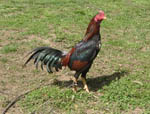
Raising roosters or game-cocks to fight each other is not only cruel, but illegal – BWC wonders how state level competitions which dole out huge prize money take place. The cocks are kept in dark rooms, away from sunlight for a week prior to events so that the stress makes them aggressive enough to fight. To raise their stamina they are fed almonds and other nuts daily, but on the day of the fight are kept hungry so that they become still more aggressive.
A razor sharp knife having a three to four inch blade is tied to one foot of each bird-contestant. They are taught to fight and kill their opponents. The duel ends when one bleeds to death due to being lethally wounded by the other bird. By then, the other is gravely injured as well. Such fights are widely organised particularly in the four districts of East Godavari, West Godavari, Krishna and Guntur of Andhra Pradesh and in Dakshina Kannada & Udupi districts of Karnataka. But, in some parts of Tamil Nadu vetrukkaal seval porr (naked heel cock-fights) are held for which the winner is decided after three or four rounds. Blades or no blades, gore, blood and money are seen. The sport is becoming more and more focused on the gambling aspect. Animal activists naturally feel it is a medieval blood sport which should be stopped, but gamblers feel just the opposite.
In response to public interest petitions filed by Animal Rescue Organisation and Bird Lovers Association, in December 2016 the Hyderabad High Court (HHC) banned cock fights and all activities associated with it like betting that ruins families overnight. The HHC directed the district collectors to constitute inspection teams and take action under the Prevention of Cruelty to Animals Act, 1960 and the AP Gaming Act, 1974. On 9 January 2017 the Supreme Court upheld the HHC’s order prohibiting cockfights.
Despite this cock fights went hi-tech with wi-fi and CCTV recordings and drone cameras to ensure punters did not cheat, to check what the roosters were fed, and believe it or not several drone cameras also hovered around the venues on the look-out for approaching police. It was estimated that on the first day of the three-day Sankranti festival punters in East and West Godavari districts where cock fights were held illegally, made Rs 80 crore. Swiping machines were borrowed from merchants and the bets were shown as purchase of items. Mobile phone transactions also took place.
The Hyderabad High Court had also cautioned politicians not to endorse the inhumane cock fights by patronising such unlawful events, but it made no difference. It is but obvious that a political will and commitment to stop cock fights in Andhra Pradesh is essential.
Cock-fighting or kozhi kettu is an illegally held blood sport at temples in Kasaragod district of Kerala. BWC therefore wrote to the District Collector in 2012 pointing out the illegality and cruelty involved: Women are not allowed to watch the gory spectacle that takes place in a ring called “cockpit”. Here too a sharp blade or knife is attached to one of leg of the cock with which it kicks the other cock. The blood is finally offered to the Theyyam Gods, believed to protect the family however gambling is now very much a part of the ritual. The Kerala Tourism website flagrantly declares “The significance and splendour of cock-fight is best reflected in almost all the folk songs of Malabar. It is one of the major rural attractions of Kasaragod district and has a legendary origin. Earlier these cock-fights were an inseparable and unavoidable part of temple festivals, especially in the northern parts of Kasaragod district. Though it is legally forbidden, cock-fights are conducted secretly in many parts of the district. In olden days a religious tint is attributed to this sport and that is why even now cock-fight is conducted in the precincts of temples. Special breeds of cocks that have great vigour and stamina are groomed for the fight. The fighter bird rises high and tries to kick the enemy bird. Usually one of the birds gets fatally wounded and dies. Sometimes the defeated bird runs off from the arena. The owner of the successful cock is entitled to get the defeated or killed cock. If both cocks are killed in the fight the owners exchange the dead birds. Large scale betting is also prevalent in many parts.” A close follow-up with the Kasaragod District Collector resulted in him forwarding our letter to the Police Chief so we expect positive action.
Gambling on Death
Under the Bombay Prevention of Gambling Act and Prevention of Cruelty to Animals’ Act hundreds of people present (including businessmen) at cock-fights held in farmhouses on the outskirts of cities have been arrested. Losing birds are immediately killed, cooked and served to guests at such parties. For example, in 2009 at a farmhouse week-end cock-fighting party in Warje village, near Panvel, the police burst a betting racket by seizing Rs 2.1 lakh, arresting 143 people, and rescuing over 25 live cocks.
On Sankranti (14th January) cock-fights are organised in the West Godavari district of Andhra Pradesh in places like Bhimavaram where heavy betting up to Rs 50 crore takes place. With such high stakes, over Rs 2 lakh is spent per bird to feed and train it for the bloody illegal fight. They are fed almonds, cashews, dry fruits, cereals, pulses, eggs, kheema (minced mutton) plus injected with muscle-building hormones and antibiotics so that they can withstand injuries during the fights. The Kshatriya community men pride themselves for participating in cock-fights and a prized cock weighing 4 to 5 kgs could be sold up to Rs 4 lakh. Unfortunately this illegal activity is carried out under political patronage of the state and claimed to be a traditional sport. To indicate their skills, the birds are categorised as dega (eagle supposed to be ferocious during afternoons), kaaki (crow) and pearl and nemali (peacock which fight better in the evenings).
In 2012 for Makar Sankranti cock-fights organised at Alipur village in Aska of Odisha’s Ganjam district were halted when the Police cracked down upon them and nabbed 20 of the 160 persons present. 26 cocks (many with knifes tied to their legs), motor-cycles, cars and cash for betting were seized and a case also registered against them for injuring a constable in retaliation.
Kanker in Chhattisgarh is a small trading outpost where during local fairs cock-fights occur at a property called the Kanker Heritage Palace.
In December 2014 a court in MP fined the owners of two roosters and ordered the birds be auctioned. They had started fighting in court where they were produced along with 12 villagers who had been arrested under the Madhya Pradesh Gambling Act for illegal betting.
Bulbul-fights
During Bhogali or Magh Bihu (the harvest festival of Assam) not only are bulbuls and cocks made to fight but buffalo-fights are also organised for thousands who come to watch. Months earlier, over 300 red-vented bulbuls (songbirds), trapped from the forest in bamboo cages, are trained to fight over a banana. A day before the fight, they are given no food, and on the day itself an herbal paste which gets them highly intoxicated. Loud drum beats and cymbals goad the birds (whose legs are tied with string) belonging to two teams, to fight all day. The winner of each duel takes on another winner till the last bird is crowned and given the banana.
The bulbuls are said to be all released back into the wild, but BWC can not understand why no action was ever been taken under the Wildlife Protection Act against the Hayagriva Madhava temple authorities at Hajo, 24 kms from Guwahati.
Beauty Without Cruelty therefore complained to the Environment Ministry officials, following which the state government prohibited bulbul-fights in January 2015. Fights between cocks and buffaloes were also banned in compliance with a Supreme Court order.
Revenge
At Midnapore (West Bengal) in 2010 a fighter-cock killed a man – the very man who had trained it to fight other cocks. The cock struck back when he was pushed to fight yet another cock. He had already won four fights by killing his opponents. So when he was forced into the arena yet again, he turned back and attacked the man by jumping upon him, cackling and flapping its wings while the razor blades tied to its feet sliced the man’s jugular vein and he bled to death as no first aid was available.
Ram-fights
Like cocks, buffaloes, bulls, cows, rams (sheep & goats), dogs and camels are made to fight males of their own kind are primitive events during which there are cases of lacerated stomachs and gouged eyes. The frenzy created by the spectators is in itself maddening for the animals. But hundreds of them are attracted to the big money involved when two of a species are illegally made to lock horns.
Kidaai Muttu is a fight between two goats or sheep and is commonly held in villages around Madurai in Tamil Nadu. They are raised on a special diet of wheat, fresh greens, vegetables, eggs and dates. Their practice sessions involve being made to run, swim and bump their heads repeatedly against hard surfaces. Their horns are sharpened and painted too. The winning goat in a competition is the one that hits others but does not get hit himself and is therefore awarded Rs 25,000/-.
Buffalo-fights continue but Bull-fights end
Although banned, 5-6 buffalo-fights are allowed by the Himachal Pradesh government at the annual Sair Fair held during September at Mashobra and Arki, on the outskirts of Shimla. Rs 35-40,000 is spent on the upkeep and training of each buffalo which is recovered during fights. Ironically the buffaloes are reluctant to fight. Their front legs are therefore tied with thick ropes and pulled by men from the back, while goading them to fight by twisting their tails. It’s cruel and painful. BWC has written to the Chief Minister more than once but these illegal fights continue to be held every year. Let’s hope that such illegal fights will end soon.
Jharkhand is known for its traditional buffalo-fights which are some times also conducted by tribal organisations, e.g. at Patamda Palashbani in December 2012. After agricultural activities are over, a buffalo fight is annually organised in some of the state’s villages like Shukla. The villagers claim it is a traditional entertainment for them in which the buffalo’s strength and fitness is showcased reflecting on how well the owner has cared for the animal – up to 10 youth work on preparing the animal for the fight by feeding and exercising it.
In Goa there is a ban on bull-fights called Dhirio in which specially reared and trained bulls fought and gored each other to death. The ban materialised thanks to a 1996 High Court judgement upheld by the Supreme Court which was obtained by the organisation People for Animals. BWC had created much awareness and obtained support especially from foreign organisations working for animals.
Second time round also when a MP moved an amendment to the Prevention of Cruelty to Animals Act 1960 to make bull-fights legal, BWC had supported upholding the ban. Eventually, in December 2009, the MP was asked by no less than the Union Minister of Environment & Forests to withdraw his bill from the Lok Sabha.
With the Government’s July 2011 Notification prohibiting bulls from being performing animals, Dhirio became history and illegal bull-fights easier to stop.
Bully-Kuttaa vs. Bully-Kuttaa
In 2012 illegal dog-fights involving betting was an increasing trend in Haryana and spreading to Punjab. Such dogs that ferociously fight each other (some times to death) are called Bully Kutaa and are similar to the vicious pit bulls which were bred specially for fighting and have been banned in many parts of the world due to their killer instincts and actions. The mastiffs are common in Pakistan (like the Kohatie Gul Terr) from where they are smuggled into India via border districts of Haryana and Punjab, particularly Fatehabad and Hisar districts of Haryana. Some might also be bred and sold here. (BWC’s investigations into greyhounds had led to the discovery of pit bulls in Punjab too at Moga, Surewala and Kotkapura.) These “dangerous” dogs are kept by people in farmhouses. Suffering is an integral part of the events – dogs suffer both physically and emotionally, whereas humans suffer due to the bets they place and lose. The Police need to quickly crack down on all such dog-fights at Gurgaon, Fatehabad and other parts of the state, before they get uncontrollable.
Unth Laddi for a Lady Camel
Called unth laddi, camels are made to fight each other at the Pushkar Fair, Rajasthan. Not much goading is required to make them fight because a female camel in heat is led in front of them and tethered nearby so they fight for her. It is considered as much a sport as the camel races mentioned above.
Our Fight to Finish…
As stated above, fights between two of a species are widespread even though Section 11(1)(n) of the Prevention of Cruelty to Animals Act forbids it. Umpteen complaints citing cruelty and illegality have over the years been sent to the Government by Beauty Without Cruelty. We therefore hope that after the Madurai Bench of the Madras High Court reaffirmed in August 2014 that cock-fights were illegal, no more animal and bird fights will take place any where in India. The earlier Supreme Court order (May 2014) further strengthened the hands of the government administration and police force.
Therefore, all that was required was political patronage to be withdrawn, and a firm political will to stop the fights. Unfortunately that did not happen: in January 2015, cock-fights were held at several places including Karur, Tamil Nadu, where many people were arrested. Cock-fights were also organised in Andhra Pradesh – one was inaugurated by the Inspector General of Police, and another by the Chief Whip of the Government. |